
In today’s fast-paced digital world, businesses face a constant challenge: deliver more value with fewer resources, and do it faster than ever before. With Business Process Automation (BPA) businesses can increase their productivity and ROI as customers expect seamless experiences, employees want simpler processes, and leadership demands measurable results. Traditional manual workflows can no longer keep up with these rising expectations—they’re too slow, too costly, and too prone to human error.
Far from being a tool that simply “cuts corners,” BPA empowers organizations to streamline repetitive tasks, reduce bottlenecks, and unlock greater efficiency across departments. Imagine invoices processed in minutes instead of days, customer requests handled instantly, or compliance reports generated automatically with zero errors. BPA is not about replacing people—it’s about freeing them from low-value tasks so they can focus on strategic, creative, and revenue-driving work. In short, it helps companies work smarter, faster, and with greater impact.
What Exactly Is BPA?
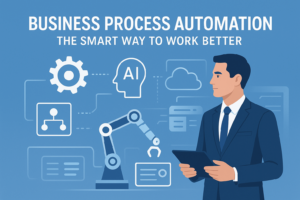
Think of Business Process Automation as your digital assistant — it takes over the repetitive, time-consuming tasks that clog up workflows, like data entry, approvals, document sorting, or report generation. It uses technology to keep things running behind the scenes, so your team can focus on more strategic, creative, or human-focused work.
Why It Matters
-
Faster Turnarounds: Automated workflows speed up everything from internal approvals to customer requests.
-
Fewer Errors: Machines don’t get tired — which means fewer mistakes and better consistency.
-
Cost Savings: By reducing manual tasks, companies cut operational expenses and reinvest in growth.
-
Scalability: As your business grows, automated systems can handle the increased workload without adding extra staff.
-
Employee Satisfaction: Teams spend less time on repetitive work and more on creative, strategic, or human-focused tasks.
How Businesses Use BPA in 2025
Today’s Business Process Automation (BPA) is smarter than ever. Thanks to AI and machine learning, it’s no longer just about automating routine tasks — it’s about creating intelligent workflows that adapt and improve.
-
Finance & Accounting: Automated invoice processing reduces delays and ensures accuracy.
-
Customer Support: Chatbots handle FAQs while agents focus on complex queries.
-
Healthcare: BPA speeds up claims processing, record management, and patient communications.
-
HR & Recruiting: From onboarding documents to leave approvals, BPA keeps everything smooth and compliant.
Trends Shaping the Future of BPA
1. Hyperautomation
BPA is merging with AI, low-code platforms, and robotics to deliver end-to-end automation. Instead of fixing one bottleneck, hyperautomation looks at the whole business process.
2. AI-Powered Decision Making
Modern Business Process Automation (BPA) tools don’t just follow rules — they learn patterns and suggest optimizations, helping businesses predict problems before they happen.
3. Low-Code/No-Code Platforms
Automation is no longer just for IT teams. With easy drag-and-drop tools, even non-technical staff can create automation flows.
4. Governance and Security
With more automation comes more responsibility. Companies now prioritize secure, compliant workflows that align with data protection laws.
Getting Started with BPA
-
Audit Your Workflows: Identify repetitive, error-prone, or time-consuming tasks.
-
Start Small: Automate one process (like approvals or reporting) and scale once you see results.
-
Choose the Right Tools: Look for platforms that integrate with your current systems.
-
Train Your Team: Get employees involved early so adoption feels natural, not forced.
-
Measure Impact: Track time saved, errors reduced, and ROI to prove value.
Conclusion
Business Process Automation is no longer about “cutting corners.” It’s about empowering organizations to work smarter, scale faster, and build resilience for the future. By automating repetitive, time-consuming tasks, businesses can reduce errors, lower costs, and improve overall efficiency. More importantly, BPA frees employees to focus on innovation, customer engagement, and strategic growth. In a world where agility and speed define competitive advantage, automation isn’t just an option—it’s a necessity.
Companies that embrace BPA today are not only optimizing current workflows but also laying a strong foundation to adapt and thrive in tomorrow’s digital landscape. By embracing automation in your workflow, you’re not just saving time — you’re unlocking innovation, empowering teams, and creating a business that runs better tomorrow.